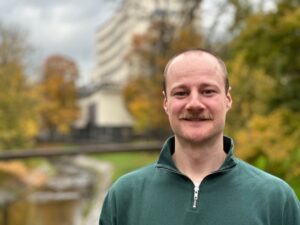
About: Fabian is a Postdoctoral Researcher at the University of Basel. His research focuses on using large-scale data from consumer- and research-grade wearable sensors to identify determinants of healthy ageing, longevity, and cardiovascular disease prevention. His interests include
biostatistics, exercise physiology, and the translation of free-living sensor data into clinically and population- relevant health outcomes.
What is a paper you recently published? What excited you about the question you answered?
In a recent study, we wanted to know whether intensity, volume, or duration of physical activity measured using accelerometers is more relevant for longevity. Specifically, we looked at all-cause and cardiovascular disease mortality. We found that the intensity of physical activity may be more important than the volume or duration for longevity. Including activities of higher intensity into daily routine may optimise health. We also investigated whether it matters if the most active minutes are spread throughout the day or performed in a single, continuous session. We found that accumulating intense activity in bouts was linked to better health outcomes than performing the same activity sporadically. What excited me about this work was that it shows how very simple choices in daily life, such as taking a purposeful 5-minute brisk walk after lunch or during a commute, rather than just moving a little bit here and there, may make a difference for long-term health. Based on these findings, turning such activities into regular habits might be a valuable way to support health over time, even though we did not study habit formation directly.
Fabian Schwendinger, Denis Infanger, Eric Lichtenstein, Timo Hinrichs, Raphael Knaier, Alex V Rowlands, Arno Schmidt-Trucksäss, Intensity or volume: the role of physical activity in longevity, European Journal of Preventive Cardiology, Volume 32, Issue 1, January 2025, Pages 10–19, https://doi.org/10.1093/eurjpc/zwae295
How do you explain your current research/job to friends and family?
I tell them that I’m a researcher who uses data from activity trackers to understand how signals from everyday life can be used to support healthier ageing and to identify opportunities to prevent heart disease earlier and more effectively.
Given unlimited funding, what would your dream research project be?
If I had unlimited funding, I’d love to lead a research project that combines established and upcoming wearable sensors to identify individuals at risk of cardiovascular disease and combine this with a targeted, individualised intervention to deliver the right behavioural or clinical support at the right time, when risk is rising, capacity is changing, or intervention is most likely to be effective.
What is your #1 piece of advice for emerging early career researchers? (And why do you say that?)
There are two pieces of advice, I think are important, but early career researchers often tend to forget.
1) Take regular breaks, not just when you feel exhausted. Stepping away now and then helps you stay clear-headed, motivated, and effective over the long term.
2) Allocate more energy to activities that move you closer to your sense of purpose and long-term direction and, if possible, be selective about commitments that absorb time without meaningfully contributing to your growth or goals.
Interested in connecting with Fabian or checking out his recent work?
