
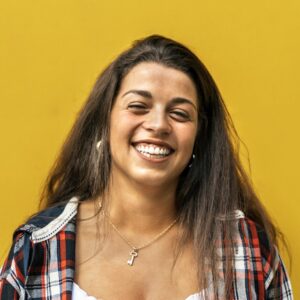
Paula is a PhD student in Epidemiology and Public Health at the University of Alcalá. Paula is collaborating on the EVERYMOVE project to design an urban index of access to physical activity, focusing on inequalities and improving the physical activity prescription processes in the national health system. As a lifelong female athlete, she became interested in gender inequalities in access to physical activity resources and their interaction with other social determinants throughout women’s lives, as well as how women perceive them. Her research aims to provide an index that reports on gender inequalities when prescribing physical activity in primary care. Learn more about Paula below!
How do you explain your current research/job to friends and family?
Women engage in significantly lower levels of physical activity (PA) due to structural, social, and environmental barriers that are intertwined and perpetuated throughout the life cycle. Our work consists of analysing these inequalities from a socio-ecological and intersectional perspective in Madrid, exploring the influence of access to exercise resources in PA levels, and how this association may be modified by gender, age, socioeconomic status and women’s perceptions. Based on qualitative and quantitative evidence, we will develop an index to assess access to physical activity resources in urban environments for women at different stages of life.
What inspired you to pursue a career in research? What drives you to continue in this path?
My motivation for research stems from a statement we often hear in the field of PA: ‘Where there’s a will, there’s a way.’ This presupposes that physical activity depends solely on individual willpower, but evidence has shown that the answer to this question is much more complex. There are structural, social and environmental barriers that limit the population, especially women, throughout their lives. After studying a Physical Activity and Sports Sciences degree and Sports Management Master, and from a gender and socio-ecological perspective, my research seeks to reduce gender inequalities in access to and participation in physical activity, and, consequently, to have a positive impact on the health of the population.
How do you envision your research impacting public health policies or practices?
The research has clear implications for public policies aimed at reducing gender inequalities in physical activity. A tool for monitoring physical activity deserts could be developed, with a special emphasis on those environments that facilitate access to exercise for women, as well as the need for strategies to reduce gender inequalities in the promotion and practice of physical activity. Policy briefs could also be published and disseminated to make this knowledge accessible. I recommend a good strategy for communicating results, differentiating between the target audience (public entities, stakeholders, athletes, the general public, etc.) in order to use different strategies.
What is your #1 piece of advice for emerging early career researchers?
My advice to those starting out in research is to be patient and learn to enjoy the process. An academic career is a marathon, not a sprint. If you find meaning in each stage – reading, analysing, writing, debating – you will build a solid and sustainable foundation. Constant curiosity, daily discipline, and maintaining the non-professional activities you enjoy are the keys to relish a career in research.
Interested in connection with Paula? Check out her LinkedIn.
